
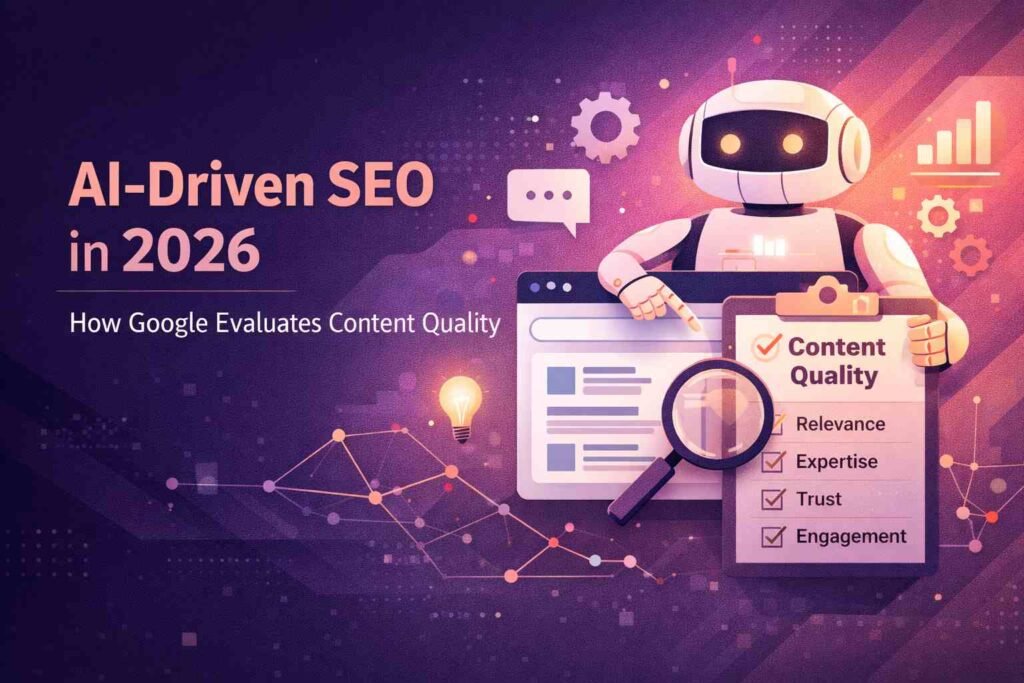
Search has moved far beyond keywords and backlinks. In 2026, visibility on Google depends on one core factor: how well your content aligns with AI-powered evaluation systems designed to understand human intent, credibility, and usefulness.
Google’s search environment now relies heavily on artificial intelligence to interpret meaning, assess trust, and predict satisfaction. As a result, SEO has shifted from tactical optimisation to intelligence-led content strategy.
This article explains how Google’s AI evaluates content today and what websites must do to stay competitive in an AI-first search landscape.
From Traditional SEO to AI-First Search
Earlier SEO strategies focused on mechanical signals such as keyword density, metadata, and link volume. While these elements still play a role, they are no longer decisive.
In 2026, Google uses AI models that function more like human reviewers. These systems analyze intent, context, expertise, trustworthiness, and real user behavior to determine relevance.
Modern SEO is no longer about optimizing pages—it is about aligning with intelligence.
How Google’s AI Interprets Search Queries
Google’s AI begins by identifying why a user is searching.
Queries are classified by purpose, including:
- Learning and discovery
- Comparison and evaluation
- Purchase intent
- Problem resolution
- Decision confirmation
Content that does not clearly serve the dominant purpose is filtered out, regardless of keyword relevance.
Ranking in 2026 depends on clarity of purpose, not keyword presence.
Holistic Content Evaluation
AI systems assess content as a complete experience rather than as individual sections.
They evaluate:
- Topic coverage and completeness
- Logical structure and clarity
- Contextual depth
- Natural language flow
- Relevance of supporting information
Pages that only skim the surface are unlikely to rank. AI favors content that demonstrates comprehensive understanding of a subject.
Trust and Authority as Ranking Signals
Trust has become one of the strongest ranking forces in AI-driven SEO.
Google’s AI evaluates trust through:
- Demonstrated expertise
- Author and brand credibility
- Consistency of information
- Experience-based insights
- Recognition beyond your website
Websites that publish inconsistently or lack authority struggle to maintain rankings, even if initial visibility is achieved.
AI Content Is Accepted, Low-Value Content Is Not
Google does not penalize content created with AI tools. However, AI systems are highly effective at identifying generic, repetitive, or unhelpful content.
Low-performing content often shows:
- Predictable phrasing
- Shallow explanations
- Excessive optimization
- No original insight
High-performing content blends AI efficiency with human reasoning, clarity, and real-world perspective.
User Behavior Influences Rankings
After content is indexed, Google’s AI evaluates how users respond to it.
Key behavioral indicators include:
- Engagement time
- Scroll depth
- Interaction signals
- Repeat visits
When users quickly leave a page, AI interprets it as unmet intent—even if the content is technically correct.
User satisfaction has become a core ranking factor.
AI Overviews and Answer-Focused Visibility
Search results increasingly feature AI-generated summaries.
To be included, content must:
- Provide direct, accurate answers
- Use clear headings and structure
- Demonstrate authority
- Anticipate follow-up questions
This has shifted SEO toward answer-first content creation, where clarity and usefulness outweigh keyword placement.
How to Align Your Content With AI-Driven SEO
To stay competitive in 2026:
- Build content around complete topics
- Focus on clarity, usefulness, and depth
- Add expert insight and human experience
- Strengthen brand trust signals
- Improve readability and navigation
- Optimize for user engagement
SEO success now depends on how well your content helps people.
Common SEO Pitfalls in the AI Era
- Writing content solely to rank
- Publishing AI content without refinement
- Ignoring reader experience
- Over-optimizing language
- Producing repetitive content
- Treating SEO as a one-time activity
FAQs: AI-Driven SEO in 2026
How is AI-driven SEO different from traditional SEO?
AI-driven SEO focuses on intent satisfaction, content depth, trust, and user behavior, while traditional SEO emphasized keywords, backlinks, and technical signals.
Can older SEO content still rank in 2026?
Yes, but only if it is updated to meet current intent, depth, and trust standards. Outdated or thin content gradually loses visibility.
Does publishing more content help AI-driven rankings?
Not necessarily. AI favors quality, relevance, and completeness over volume. Fewer high-value pages outperform large volumes of shallow content.
How does Google’s AI measure content usefulness?
By analyzing engagement metrics, contextual relevance, topic coverage, and whether users continue their journey or return to search results.
Are long-form articles better for AI-driven SEO?
Length alone does not matter. Content must be comprehensive without being repetitive and should fully address the topic and related questions.
How important is niche expertise in AI-driven SEO?
Extremely important. Google’s AI prioritizes websites that consistently demonstrate expertise within a specific subject area.
Will SEO become fully automated in the future?
No. While AI will automate analysis and assistance, human insight, strategy, and experience will remain essential for meaningful rankings.
Final Thoughts
AI-driven SEO has reshaped how content is judged and ranked.
Success in 2026 comes from:
- Understanding user intent
- Delivering depth and clarity
- Building trust over time
- Enhancing user experience
SEO is no longer about keeping up with algorithms—it is about earning relevance in an intelligent search ecosystem.