
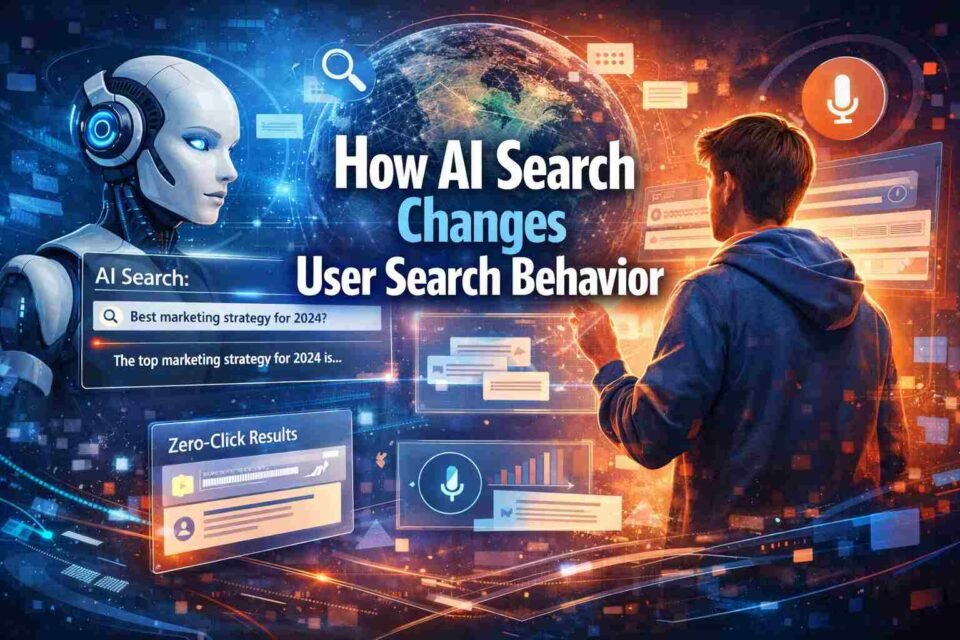
Search behavior is evolving at an unprecedented pace. With the rise of AI-powered search experiences, users no longer search, click, and compare the way they once did. Instead, search has become conversational, instant, and decision-oriented. AI search systems interpret intent, summarize knowledge, and guide users—fundamentally changing how people discover and trust information online.
Understanding this shift is critical for marketers, content creators, and businesses aiming to stay visible in the modern search ecosystem.
Search Has Shifted From Exploration to Expectation
Contents
Earlier, users explored search results by opening multiple links and forming conclusions themselves. AI search has replaced this with a new expectation: the best answer should appear immediately. Users now assume search engines will understand their question, process context, and deliver a ready-to-use response.
As a result, browsing behavior has reduced, and dependence on AI-generated summaries has increased.
Questions Are More Intent-Driven and Detailed
AI search encourages users to ask clearer, more specific questions. Because AI understands nuance, users include goals, constraints, and context in a single query.
This change reflects a move away from keyword guessing toward intent clarity, where users expect accurate answers without repeated searches.
Search Is Becoming a Guidance and Decision Tool
Modern AI search is not limited to information retrieval—it actively supports decision-making. Users increasingly ask comparison-based and recommendation-driven questions, expecting pros, cons, and next steps in one place.
This behavior shortens research cycles and accelerates decisions, especially for tools, services, and strategies.
Fewer Clicks, Greater Influence
AI search has reduced traditional click-through behavior, particularly for informational queries. Many users feel satisfied with AI-generated answers and never visit the source websites.
However, influence still exists. Content that AI systems reference shapes opinions, builds trust, and impacts decisions—even without direct traffic. Visibility is no longer measured by clicks alone.
Trust Is Shifting Toward AI-Curated Answers
Users increasingly trust AI-generated responses because they appear fast, neutral, and comprehensive. Instead of evaluating multiple sources, users rely on AI as a filtering layer.
Trust now builds when content is consistently used or referenced by AI, rather than solely through website visits or brand familiarity.
Personalization Is Reducing Search Effort
AI search adapts responses based on user context, preferences, and location. This reduces the need for users to refine queries repeatedly.
As a result, users have less tolerance for generic answers and expect relevance on the first attempt. Personalization has become a baseline expectation.
Conversational Follow-Ups Are Replacing New Searches
Search is no longer a single action. AI encourages follow-up questions within the same context, turning search into an ongoing dialogue.
Users now build on previous answers with prompts like “explain this simply” or “what should I do next,” making search more interactive and continuous.
Frequently Asked Questions (FAQs)
1. What distinguishes AI search from conventional search?
AI search focuses on understanding intent and delivering direct, contextual answers, while traditional search primarily lists web pages based on keywords.
2. Why do users click fewer websites with AI search?
AI summaries often satisfy informational needs instantly, reducing the need to visit multiple websites unless deeper details are required.
3. Does AI search reduce website traffic completely?
No. While basic queries may generate fewer clicks, AI search increases the importance of authority, brand mentions, and influence beyond direct traffic.
4. How has AI search changed the way users ask questions?
Users now ask longer, conversational, and more specific questions because AI can understand context and nuance.
5. Are users becoming less loyal to websites?
Users are becoming more loyal to accurate answers rather than specific sites, unless brands consistently build visibility and trust.
6. How does AI search affect buying decisions?
AI search speeds up decision-making by providing comparisons, explanations, and recommendations in one place.
7. Is traditional SEO still relevant?
Yes, but SEO now emphasizes intent, topical authority, clarity, and trust—not just keywords and rankings.
Final Perspective
The way people find information has been irreversibly altered by AI search. People now expect instant clarity, personalized guidance, and conversational interaction. They search differently, click less, and rely heavily on AI-curated insights.
For brands and content creators, success lies in adapting to this reality—creating clear, authoritative, and genuinely helpful content that aligns with how modern users search, think, and decide.
