
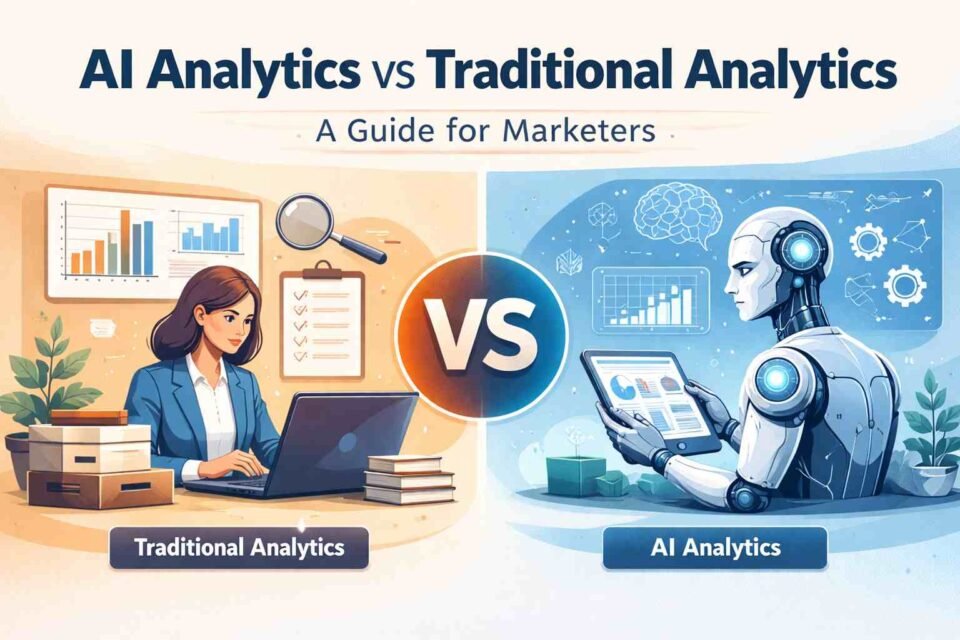
Data has always played a central role in marketing, but the way marketers analyze and act on data has changed significantly. Traditional analytics methods that once guided decision-making are now being complemented—and in many cases overtaken—by AI-powered analytics.
As customer behavior becomes more complex and digital channels multiply, marketers must understand the differences between AI analytics and traditional analytics to make smarter, faster, and more profitable decisions.
What Is Traditional Analytics?
Contents
Traditional analytics focuses on analyzing historical data using predefined metrics and fixed rules. It helps marketers understand past performance and identify trends based on structured datasets.
Core Features of Traditional Analytics
- Analyzes historical data
- Uses static dashboards and reports
- Requires manual interpretation
- Best suited for structured data
- Offers descriptive insights
Traditional analytics answers questions such as what happened last month or which campaign performed better.
What Is AI Analytics?
AI analytics uses artificial intelligence and machine learning to process large volumes of data automatically. It not only analyzes past and current data but also predicts future outcomes and suggests actions.
Core Features of AI Analytics
- Learns from data continuously
- Processes structured and unstructured data
- Provides real-time insights
- Predicts customer behavior
- Automates decision-making
AI analytics shifts the focus from reporting to intelligent decision support.
AI Analytics vs Traditional Analytics: Key Differences Marketers Should Know
1. Data Processing and Speed
Traditional analytics processes data at set intervals, which can delay insights. AI analytics works in real time, allowing immediate responses to changes in user behavior.
Advantage: AI Analytics
2. Type of Insights
Traditional analytics delivers descriptive insights focused on past events. AI analytics provides predictive and prescriptive insights that guide future actions.
Advantage: AI Analytics
3. Predictive Power
Traditional analytics explains performance but cannot forecast outcomes accurately. AI analytics predicts trends such as conversions, churn, and demand.
Advantage: AI Analytics
4. Personalization Capabilities
Traditional analytics enables basic audience segmentation. AI analytics enables hyper-personalized experiences using real-time behavior data.
Advantage: AI Analytics
5. Human Effort and Automation
Traditional analytics depends heavily on analysts. AI analytics automates data interpretation, freeing marketers to focus on strategy.
Advantage: AI Analytics
6. Scalability
Traditional analytics struggles with large datasets. AI analytics scales easily as data volume grows.
Advantage: AI Analytics
7. Cost and Accessibility
Traditional analytics tools are easier to implement and cost less initially. AI analytics requires investment but delivers higher long-term ROI.
Short-term Advantage: Traditional Analytics
Long-term Advantage: AI Analytics
When Traditional Analytics Is the Right Choice
Traditional analytics remains valuable when:
- Tracking essential KPIs
- Managing small campaigns
- Working with limited data
- Creating compliance or audit reports
- Operating with limited budgets
It provides clarity and control, especially for early-stage businesses.
When AI Analytics Becomes a Necessity
AI analytics is essential when:
- Managing large or complex datasets
- Running multi-channel campaigns
- Optimizing advertising spend dynamically
- Predicting customer behavior
- Delivering personalized experiences
For growing brands, AI analytics becomes a competitive advantage.
The Best Strategy: Using AI and Traditional Analytics Together
Rather than choosing one approach, smart marketers combine both. Traditional analytics provides historical context, while AI analytics delivers foresight and automation.
- Validate AI predictions
- Reduce risk
- Improve accuracy
- Maximize marketing performance
Final Thoughts
Traditional analytics laid the foundation for data-driven marketing, but today’s fast-paced digital environment demands more. AI analytics transforms data into actionable intelligence, helping marketers move from reactive decisions to proactive strategies.
Marketers who embrace AI analytics alongside traditional methods are better equipped to stay competitive, increase ROI, and adapt to future trends.
Frequently Asked Questions (FAQs)
1. What is the biggest advantage of AI analytics over traditional analytics?
AI analytics offers predictive and real-time insights, enabling marketers to anticipate trends and act faster than traditional analytics.
2. Is traditional analytics becoming obsolete?
No. Traditional analytics is still useful for reporting and historical analysis, but it works best when combined with AI analytics.
3. Do marketers need technical skills to use AI analytics?
Most modern AI analytics tools are user-friendly and require minimal technical expertise.
4. Can AI analytics improve customer experience?
Yes. AI analytics analyzes real-time behavior to deliver personalized content and messaging.
5. How does AI analytics help reduce marketing costs?
AI analytics optimizes ad spend, reduces wasted campaigns, and improves targeting accuracy.
6. Is AI analytics suitable for startups?
Yes. Many AI tools offer scalable pricing suitable for startups.
7. What data sources can AI analytics integrate?
AI analytics can integrate data from websites, social media, CRM systems, ad platforms, emails, and customer feedback.
8. Are AI analytics insights always accurate?
Accuracy depends on data quality. Clean, structured data improves prediction reliability.
9. Can AI analytics support SEO strategies?
Yes. AI analytics helps identify keyword trends, user intent, and content gaps.
10. Will AI analytics replace marketing analysts?
No. AI analytics supports analysts while humans focus on strategy and creativity.
