
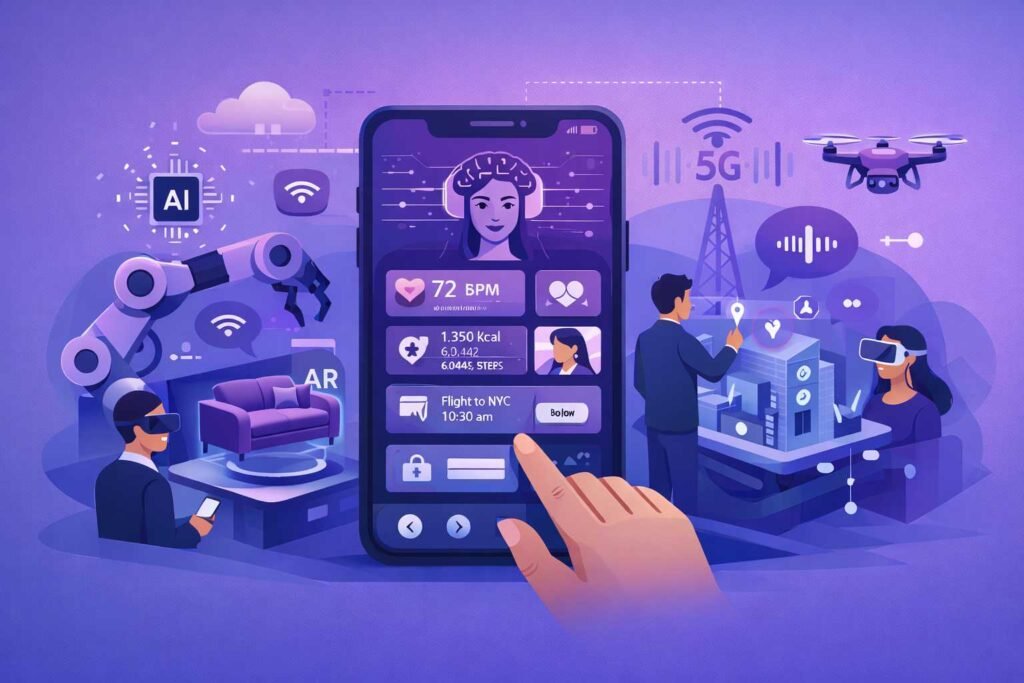
Mobile apps in 2026 are no longer judged only by features or aesthetics. Users now expect intelligent behavior, intuitive design, and seamless interaction across every touchpoint. The rapid evolution of AI, connectivity, and device capabilities has fundamentally reshaped what people consider a “good app.”
In this new era, apps are expected to anticipate needs, adapt instantly, protect privacy, and deliver value without friction. Let’s explore the most important mobile app trends in 2026 that are redefining user engagement and setting new experience benchmarks.
Apps That Learn and Improve Automatically
Users in 2026 expect apps to get smarter the more they use them. Static functionality feels outdated. Modern apps continuously learn from behavior and refine experiences without manual updates.
These intelligent apps:
- Adjust workflows based on usage patterns
- Prioritize features differently for each user
- Improve accuracy and relevance over time
- Reduce unnecessary steps automatically
For users, this means less effort and more meaningful interactions.
Personalized Experiences as a Default Expectation
Personalization is no longer a premium feature—it’s a baseline requirement. Users now expect apps to reflect their preferences from the first interaction onward.
Modern personalization includes:
- Adaptive layouts and navigation
- Content tailored to real-time context
- Smart notifications aligned with user intent
- Predictive suggestions instead of manual searches
Apps that fail to personalize quickly feel generic and are often abandoned.
Faster, Smarter Apps Powered by On-Device Intelligence
Speed and privacy have become inseparable in 2026. Users expect instant responses without sacrificing data security. This has accelerated the adoption of on-device intelligence, where processing happens directly on the user’s device.
Key user benefits include:
- Minimal latency
- Offline functionality
- Reduced data sharing
- Better battery optimization
This shift has raised expectations around trust, performance, and reliability.
Conversational and Voice-Based App Experiences
Typing is no longer the dominant mode of interaction. Users now expect apps to understand voice commands, natural language, and conversational inputs.
Popular expectations include:
- In-app AI assistants
- Voice-driven navigation
- Smart chat interfaces
- Hands-free interactions
Apps that embrace conversational design feel more human and accessible.
Fewer Apps, More Capabilities
App overload has pushed users toward platforms that offer multiple services in one place. In 2026, users increasingly prefer apps that reduce clutter while increasing convenience.
These multi-functional platforms offer:
- Unified dashboards
- Seamless feature switching
- Single sign-on experiences
- Centralized notifications
Convenience has become a major driver of user loyalty.
Immersive Interfaces That Go Beyond Screens
Users are no longer satisfied with flat, passive interfaces. Immersive experiences are becoming part of everyday mobile usage.
Expectations now include:
- Interactive visual elements
- Augmented reality previews
- 3D navigation and exploration
- Context-aware visual feedback
These experiences make apps more engaging and memorable.
Privacy Transparency as a Trust Signal
In 2026, users actively choose apps based on how responsibly they handle data. Privacy is no longer hidden in policies—it’s part of the user experience.
Users expect:
- Clear permission explanations
- Control over personal data
- Minimal data collection
- Secure authentication methods
Apps that communicate transparency earn long-term trust.
Zero-Tolerance for Slow Performance
With advanced networks and powerful devices, users have little patience for delays. Performance issues are seen as poor design rather than technical limitations.
Performance expectations include:
- Instant screen transitions
- Smooth animations
- Real-time updates
- Low battery and data usage
Speed is now a critical part of perceived quality.
Predictive Design That Reduces User Effort
Apps in 2026 are expected to take initiative. Users want systems that anticipate actions instead of reacting to commands.
Predictive design allows apps to:
- Surface relevant features at the right moment
- Minimize repetitive input
- Deliver timely suggestions
- Prevent errors before they occur
This creates frictionless and intuitive experiences.
Seamless Experiences Across Devices
Users move effortlessly between smartphones, wearables, tablets, and desktops. They expect continuity without disruption.
Cross-device expectations include:
- Real-time synchronization
- Consistent design language
- Unified user profiles
- Smooth session transitions
Apps that break continuity lose credibility.
Ethical Design Influencing App Choices
Users are becoming more aware of how apps influence decisions and behavior. Ethical design is now part of the evaluation process.
Modern expectations include:
- Fair algorithms
- Explainable recommendations
- User control over automation
- Responsible AI behavior
Ethical apps build deeper emotional trust.
FAQs: Mobile App Trends in 2026
Why are mobile apps changing so rapidly in 2026?
Advancements in AI, device hardware, and connectivity have accelerated innovation while raising user expectations.
What do users expect most from mobile apps today?
Speed, personalization, privacy, and intuitive design are the most critical expectations.
Are traditional mobile apps becoming obsolete?
Not obsolete, but apps that fail to evolve with intelligent and user-centric design struggle to retain users.
How important is privacy in modern mobile apps?
Privacy is a key decision factor and directly impacts trust, retention, and brand perception.
Do immersive features improve user engagement?
Yes. Interactive and immersive elements increase engagement, recall, and satisfaction when used purposefully.
Final Thoughts
Mobile app trends in 2026 reflect a deeper shift in user mindset. People no longer want tools—they want intelligent experiences that feel effortless, personal, and trustworthy.
Businesses that design apps around these evolving expectations will see stronger engagement, higher retention, and long-term growth. Those that don’t risk being left behind in a rapidly maturing mobile ecosystem.