
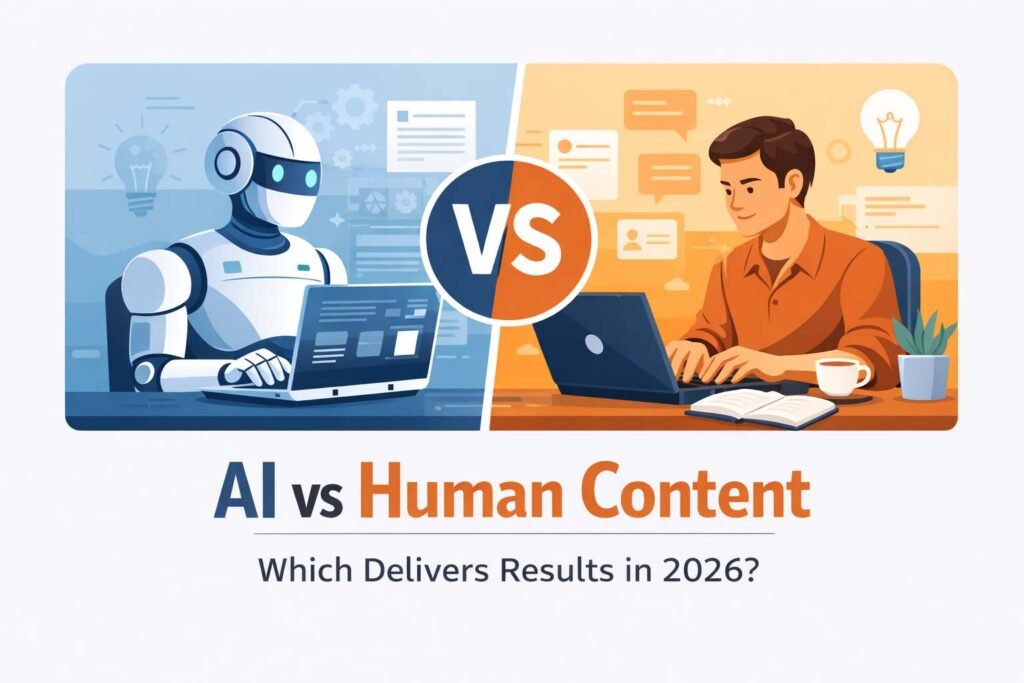
By 2026, content creation is no longer a purely human-driven activity. Artificial Intelligence now writes blogs, generates marketing copy, and optimizes content for search engines in seconds. As a result, businesses face a critical decision: Should they rely on AI content, human writers, or a combination of both?
This question goes beyond productivity. It directly affects SEO performance, brand trust, audience engagement, and conversions. In this article, we explore how AI content and human content actually perform in 2026—and which approach delivers sustainable results.
How AI Content Has Evolved by 2026
AI content tools in 2026 are far more advanced than early-generation systems. They understand context, predict user intent, and align content with current search trends. AI can now:
- Generate long-form SEO articles
- Suggest optimized headings and internal links
- Create summaries, FAQs, and meta tags
- Adapt tone for different audiences
The Practical Advantage of AI
AI excels in operational efficiency. Businesses use AI to:
- Publish content consistently
- Scale blogs for SEO campaigns
- Reduce content production costs
- Maintain structured, keyword-aligned pages
For informational and top-of-funnel content, AI delivers speed and structure that human teams alone cannot match.
Where AI Content Falls Short
Despite its capabilities, AI still struggles with elements that define high-impact content.
AI content often:
- Sounds generic across industries
- Lacks personal experience or real examples
- Struggles with emotional storytelling
- Misses subtle brand voice nuances
In 2026, audiences are more content-aware than ever. They can easily identify content that feels automated rather than intentional.
The Value of Human Content in 2026
Human writers remain essential because they bring judgment, creativity, and credibility into content. Unlike AI, humans understand emotional triggers, cultural context, and strategic messaging.
What Human Writers Do Best
Human-written content excels at:
- Building brand authority
- Sharing first-hand experience
- Creating persuasive narratives
- Addressing complex or sensitive topics
- Establishing long-term audience trust
In areas such as B2B marketing, thought leadership, and conversion-focused pages, human content consistently outperforms AI-generated text.
AI vs Human Content: Performance Comparison in 2026
| Criteria | AI Content | Human Content |
| Content Speed | Very High | Moderate |
| Cost Efficiency | High | Lower |
| Original Insight | Limited | Strong |
| Emotional Engagement | Weak | Strong |
| SEO Structure | Excellent | Strategic |
| Trust & Credibility | Moderate | High |
| Conversion Potential | Medium | High |
AI delivers volume, while humans deliver impact.
What Actually Ranks on Google in 2026?
Google’s ranking systems in 2026 prioritize helpfulness, depth, and trust. The source of the content—AI or human—is not the deciding factor. What matters is:
- Does the content solve a real problem?
- Is it original and insightful?
- Does it demonstrate experience?
- Is it accurate and trustworthy?
AI-generated content that is published without human review often fails to meet these expectations. On the other hand, human-enhanced AI content performs exceptionally well.
The Rise of the Hybrid Content Model
The most successful brands in 2026 no longer debate AI versus humans. Instead, they use both strategically.
How Hybrid Content Creation Works
- AI supports research, outlines, and SEO alignment
- Humans refine messaging, insights, and tone
- Editors ensure clarity, originality, and accuracy
- Marketers optimize content for audience intent
This model balances speed with substance, allowing brands to scale content without sacrificing quality.
Can AI Replace Human Writers?
AI will not replace human writers—but it will redefine their role.
Writers who only produce basic content are increasingly replaceable. Writers who:
- Think strategically
- Understand SEO deeply
- Add real experience and perspective
- Build authority-driven content
…are more valuable than ever in 2026.
Choosing the Right Approach for Your Business
- Use AI content for scalable SEO blogs, FAQs, and informational pages
- Use human content for branding, storytelling, and conversions
- Use a hybrid strategy for long-term SEO growth and trust
There is no single winner—only smarter implementation.
Final Thoughts
In 2026, the real question is not AI vs human content. The real question is how intelligently you combine both.
AI brings efficiency. Humans bring meaning. Together, they create content that ranks, converts, and builds trust.
Frequently Asked Questions: AI vs Human Content in 2026
1. Why are businesses using AI content more aggressively in 2026?
Businesses are using AI content more aggressively in 2026 because it allows them to publish content faster, reduce production costs, and maintain consistency across digital platforms.
2. Does AI-written content affect brand credibility?
AI-written content alone can weaken brand credibility if it sounds generic or lacks authenticity. Credibility improves significantly when AI content is reviewed and enhanced by human editors.
3. How do users perceive AI content compared to human content?
Human-written or human-refined content tends to feel more trustworthy, engaging, and relatable, especially for decision-making content.
4. Can AI-generated content support long-term SEO growth?
Yes, when used strategically with regular updates, original insights, and quality control.
5. Is AI content suitable for niche or specialized industries?
AI content can assist with research and structure, but expert review is essential for accuracy and compliance.
6. How do companies maintain originality when using AI tools?
- Using AI for drafts, not final output
- Adding internal data, examples, and opinions
- Editing for brand voice and tone
- Applying plagiarism and quality checks
This process ensures content remains unique and brand-specific.
7. Does AI content perform well for audience engagement?
AI content performs well for informational engagement but often struggles with emotional engagement.
8. What role do content editors play in AI-driven workflows?
Editors verify facts, refine language, align messaging with brand goals, and ensure quality standards.
9. Should startups rely more on AI or human content?
A balanced approach is ideal—AI for scalability, humans for trust and positioning.
10. What content strategy will dominate beyond 2026?
Collaborative content creation, where AI supports efficiency and humans lead creativity, ethics, and strategy.